How to Find Your German Ancestors: A Complete Guide to Planning a German Heritage Journey
How Your Family History Can Become the Journey of a Lifetime
For millions of people around the world, Germany is more than a travel destination—it is the home land of their ancestors. Whether your great-grandparents emigrated to the United States, Canada, Australia, South America, or elsewhere, your family’s story may have begun in a small German village, a historic city, or a farming community that still exists today.
A German Heritage Journey is much more than sightseeing. It is an opportunity to reconnect with your family’s history, visit the places where your ancestors lived, explore historical records, and experience Germany through a deeply personal perspective.
At Gate of Nations GmbH, we believe every family has a unique story waiting to be rediscovered. This guide explains how to begin your search and transform your family history into an unforgettable travel experience.
Why Are So Many People Searching for Their German Roots?
Germany has one of the world’s largest diasporas. During the eighteenth, nineteenth, and early twentieth centuries, millions of Germans emigrated to North America, South America, Australia, and other parts of the world in search of new opportunities.
Today, many descendants are asking questions such as:
- Where did my family come from?
- What village did my ancestors live in?
- Can I visit their hometown?
- Does my family home still exist?
- Are church records or family archives available?
- Can I meet distant relatives?
Modern genealogy tools and historical archives have made it easier than ever to begin answering these questions.
Step 1 – Start with Your Own Family
Every successful genealogy journey begins at home.
Talk to your parents, grandparents, aunts, and uncles. Ask them about:
- Family names
- Birthplaces
- Immigration stories
- Old letters
- Family Bibles
- Marriage certificates
- Birth certificates
- Military documents
- Photographs
- Passenger lists
Even a small detail—such as the name of a village or church—can become an important clue.
Step 2 – Collect Historical Documents
The more information you gather before traveling, the more rewarding your journey will be.
Helpful documents include:
- Birth certificates
- Marriage records
- Death certificates
- Immigration papers
- Naturalization records
- Census records
- Military service documents
- Old passports
- Family correspondence
These documents often reveal locations, dates, occupations, and family relationships.
Step 3 – Use Online Genealogy Resources
Many historical records have now been digitized.
Popular genealogy resources include:
- Family Search
- Ancestry
- My Heritage
- German regional archives
- Church archives
- Local historical societies
These databases may help identify:
- Family names
- Places of birth
- Immigration records
- Marriage records
- Church registrations
However, many valuable records still exist only in local German archives.
Step 4 – Identify Your Ancestors’ Hometown
Finding the exact hometown is often the most important milestone in German genealogy research.
Germany has thousands of towns and villages, and many families share the same surname. Knowing the correct location allows researchers to search church books, municipal archives, cemetery records, and local historical collections with much greater accuracy.
Once the hometown is identified, your heritage journey becomes truly personal.
Step 5 – Visit Germany
Reading historical documents is fascinating, but standing where your ancestors once lived is an entirely different experience.
Imagine:
Walking through the same streets…
Visiting the church where generations of your family were baptized…
Seeing the landscapes they admired every day…
Meeting local historians who understand the history of your family’s community…
These moments create memories that no family tree alone can provide.
What Can You Experience During a German Heritage Journey?
Every itinerary is different, but many heritage travelers choose to include:
Visits to Family Villages
Explore historic villages, market squares, churches, and neighborhoods connected to your family history.
Historical Archives
Municipal archives often contain valuable historical documents, maps, and local records.
Church Records
Many German churches preserve baptism, marriage, and burial records dating back hundreds of years.
Historic Cemeteries
Family gravestones can provide additional names, dates, and relationships that enrich your understanding of your ancestry.
Local Museums
Regional museums offer insight into daily life during the periods when your ancestors lived there.
Traditional German Culture
Enjoy authentic regional cuisine, festivals, music, architecture, and local traditions that reflect your family’s cultural heritage.
Beyond Genealogy – Discover Germany
While tracing your ancestry, you can also experience some of Germany’s most remarkable destinations.
Popular highlights include:
- The Romantic Road
- Neuschwanstein Castle
- Heidelberg
- The Rhine Valley
- Berlin
- Munich
- Dresden
- Rothenburg ob der Tauber
- The Black Forest
- UNESCO World Heritage Sites
Combining genealogy with cultural exploration creates a truly unforgettable journey.
Is a German Heritage Journey Right for You?
This type of travel is perfect for:
- Families with German ancestry
- Genealogy enthusiasts
- History lovers
- Multi-generational family groups
- Retired travelers
- Luxury travelers seeking meaningful experiences
- Anyone interested in discovering their family’s story
No previous genealogy experience is required.
Planning Your Heritage Journey
Because every family history is unique, every itinerary should be individually designed.
Professional heritage travel planning typically includes:
- Preliminary family history research
- Consultation before departure
- Customized itinerary
- Private transportation
- English-speaking guides
- Archive appointments where available
- Cultural experiences
- Premium accommodations
Personalized planning ensures your time in Germany is focused on the places and stories that matter most.
Frequently Asked Questions
How long should a German Heritage Journey be?
Most travelers choose between 8 and 14 days, depending on the number of regions they wish to visit.
Do I need to know exactly where my ancestors came from?
No. Even partial information can often help guide further research before your trip.
Can I visit archives and churches?
Yes, many archives and churches welcome researchers, although appointments may be required.
Will I find living relatives?
Sometimes. While it cannot be guaranteed, professional research may identify possible family connections or local contacts.
Can my journey include famous German attractions?
Absolutely. Most heritage travelers combine genealogy with castles, scenic routes, museums, culinary experiences, and cultural highlights.
Begin Your Own Story
Every family history deserves to be explored, preserved, and shared with future generations.
A German Heritage Journey is more than a vacation. It is an opportunity to understand where your family came from, celebrate your heritage, and create lasting memories in the country that shaped your ancestors’ lives.
Whether your roots lead to a small village in Bavaria, a vineyard along the Rhine, a Hanseatic town in northern Germany, or a historic city in Saxony, Germany offers countless opportunities to reconnect with your past.
Your family’s story began somewhere.
Perhaps your next journey is the beginning of discovering it.
About Gate of Nations GmbH
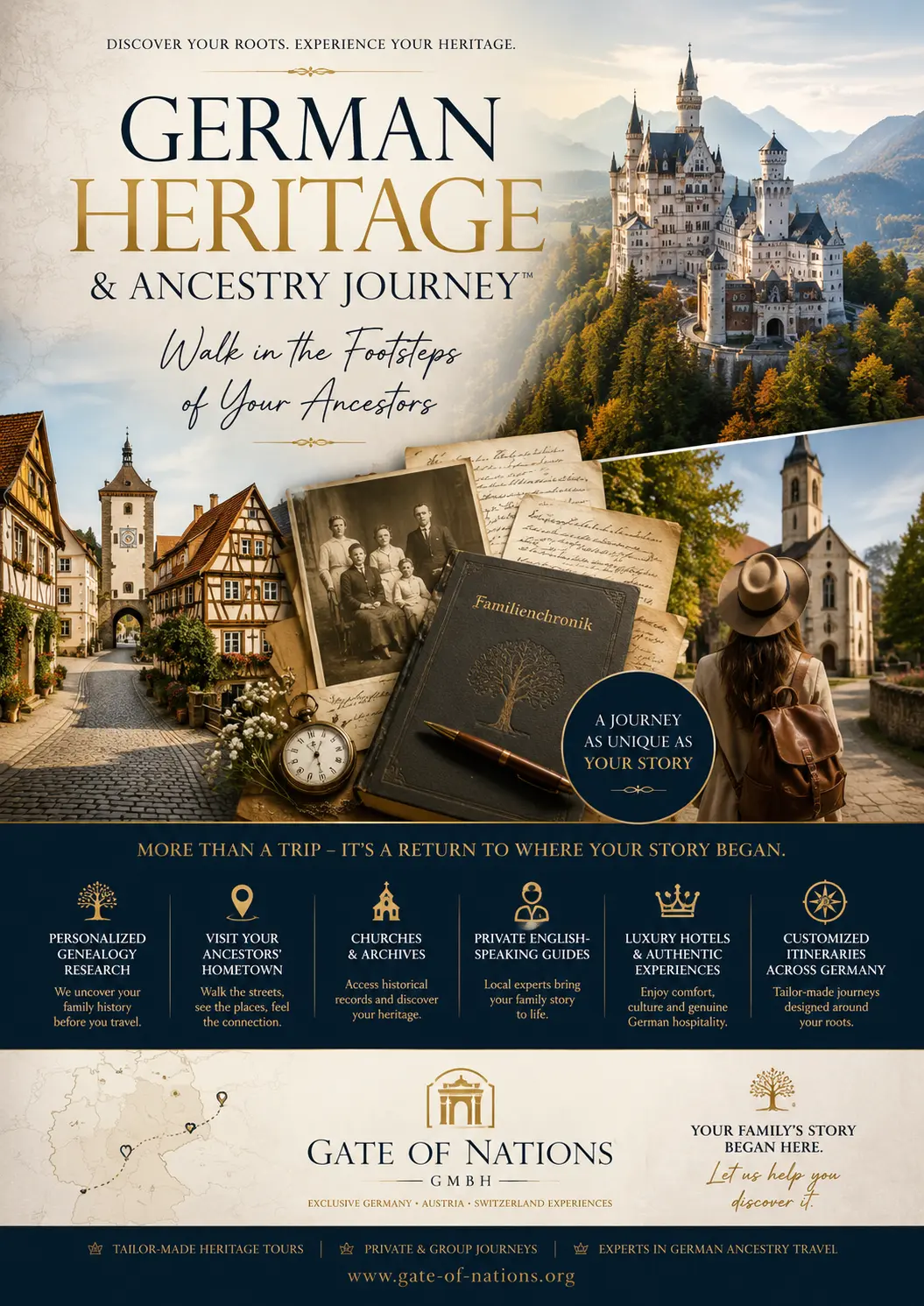
Gate of Nations GmbH is a German Destination Management Company (DMC) specializing in tailor-made journeys throughout Germany, Austria, and Switzerland. We design personalized heritage, cultural, luxury, and private tours for international travelers seeking authentic experiences and exceptional service.
If you are ready to explore your German roots, our travel specialists are here to help you create a customized German Heritage & Ancestry Journey that reflects your family’s unique story.